Software
Journal Club
-
Presented by Zixuan:
Density Functional Theory Surrogate Enables Fast and Broad
Computational Evaluation of Homogeneous Transition Metal Catalytic
Energy Landscapes,
Link to paper .
-
Presented by Lewen:
Yield Smarter, Not Harder: Good Practices for Machine Learning of
Reaction Outcomes,
Link to paper .
-
Presented by Kenyon:
Nickel-Catalyzed Remote Substitution of Alcohols,
Link to paper .
-
Presented by Ryan:
Retrosynformer: Planning MultiStep Chemical Synthesis Routes via a
Decision Transformer, Link to paper .
-
Presented by Jiseung:
Machine Learning of Accurate Energy-Conserving Molecular Force
Fields, Link to paper .
-
Presented by Andrei:
A Deep Learning Approach to Antibiotic Discovery,
Link to paper .
-
Presented by Huiwen:
A Review of Automated Workflow Pipelines for Computational
Chemists,
Link to paper .
-
Presented by Thomas:
Rethinking the Nature and Extent of Inductive Effects in Organic
Compounds,
Link to paper .
-
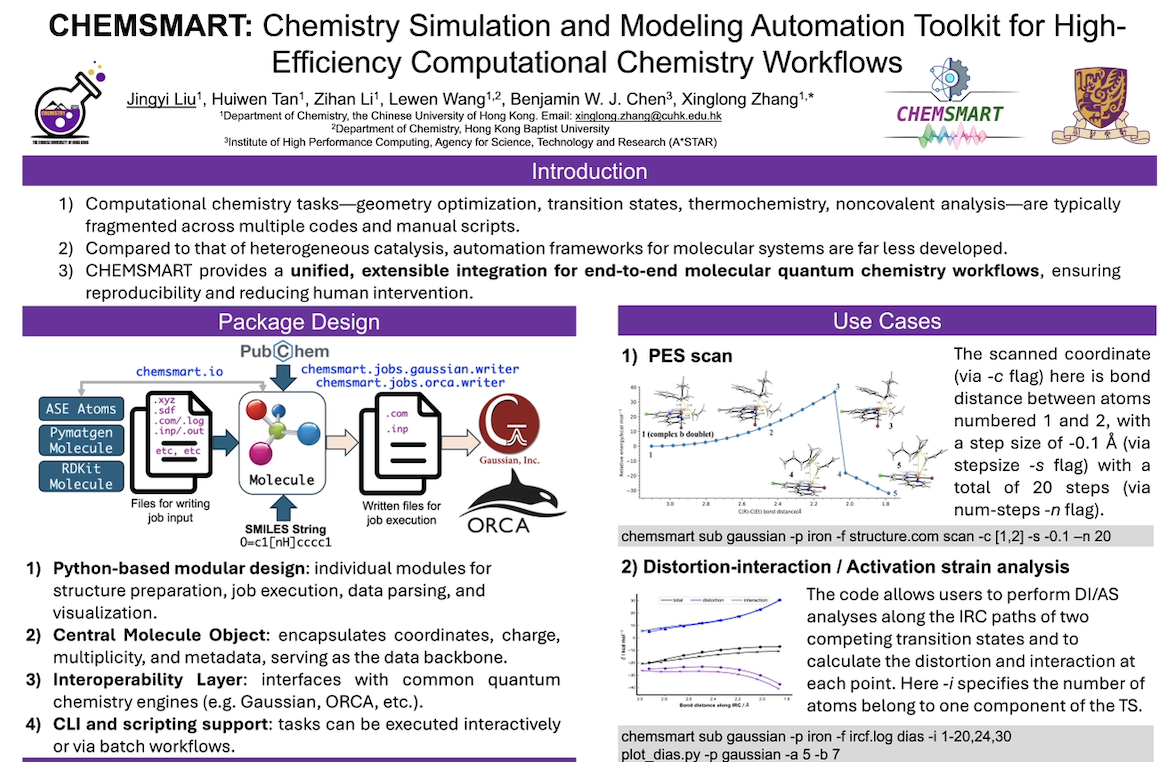
Presented by Jingyi:
Open-Source, Python-Based Redevelopment of the ChemShell
Multiscale QM/MM Environment,
Link to paper .
-
Presented by Zihan:
Hybrid Computational Strategy for Predicting Complex Ligand–Metal
Architectures,
Link to paper .
-
Presented by Aixin:
gmx_ffconv: A Fast and User-Friendly Semi-Automated All-Atom Force
Field Converter for GROMACS,
Link to paper .
-
Presented by Lewen:
Machine Learning for De Novo Molecular Generation: A Comprehensive
Review,
Link to paper.
-
Presented by Huiwen:
AiiDA: automated interactive infrastructure and database for
computational science,
Link to paper.
-
Presented by Jingyi:
The dark side of the forces: assessing non-conservative force
models for atomistic machine learning, Link to paper.
-
Presented by Zihan:
Transferable Enantioselectivity Models from Sparse Data,
Link to paper.
-
Presented by Lewen:
A practical inverse design approach for high-entropy catalysts
using generative AI,
Link to paper.
-
Presented by Huiwen:
Managing the computational chemistry big data problem: the
ioChem-BD platform,
Link to paper.
-
Presented by Jingyi:
Ab initio characterization of protein molecular dynamics with
AI2BMD,
Link to paper.
-
Presented by Lewen:
Large language model guided automated reaction pathway
exploration,
Link to paper.
-
Presented by Huiwen:
E(3)-equivariant graph neural networks for data-efficient and
accurate interatomic potential,
Link to paper.
-
Presented by Jingyi:
Auto-Qchem: an automated workflow for the generation and storage
of DFT calculations for organic molecules, Link to paper.
-
Presented by Yu:
UMA: A Family of Universal Models for Atoms, Link to paper.
-
Presented by Sum Ming:
Sampling 3D Molecular Conformers with Diffusion Transformers, Link to paper.
-
Presented by Zihan:
Constructing and explaining machine learning models for chemistry:
example of the exploration and design of boron-based Lewis
acids,
Link to paper.
-
Presented by Huiwen:
Ab initio solution of the many-electron Schrödinger
equation with deep neural networks,
Link to paper.
-
Presented by Lewen:
Chemception: A Deep Neural Network with Minimal Chemistry
Knowledge Matches the Performance of Expert-developed QSAR/QSPR
Models, Link to paper.
-
Presented by Sum Ming:
Comparing SMILES and SELFIES tokenization for enhanced chemical
language modeling,
Link to paper.
-
Presented by Isha:
Materials Synthesis Insights from Scientific Literature via Text
Extraction and Machine Learning,
Link to paper.
-
Presented by Ansh:
Leveraging large language models for predictive chemistry,
Link to paper.
-
Presented by Zihan:
Data extraction from polymer literature using large language
models,
Link to paper.
-
Presented by Jingyi:
Large language models for scientific discovery in molecular
property prediction,
Link to paper.
-
Presented by Zihan:
Toward a unified benchmark and framework for deep learning-based
prediction of nuclear magnetic resonance chemical shifts,
Link to paper.
-
Presented by Jingyi:
Baseline Correction Using a Deep-learning Model Combining ResNet
and UNet,
Link to paper.
-
Presented by Huiwen:
A review of large language models and autonomous agents in
chemistry,
Link to paper.
-
Presented by Zihan:
An automatic end-to-end chemical synthesis development platform
powered by large language models,
Link to paper.
For Undergraduates
I must duly acknowledge that some of the materials are drawn freely from
my undergraduate lecture notes. Where the explanations in the notes are
unclear, or too brief, to the point where the actual derivations become
difficult for some students, I attempt to make this clearer by explaining
using my own reasoning. It should be noted, however, that any mistakes
herein are mine and mine alone. Please send any suggestions and/or
corrections to
xinglong.zhang[AT]cuhk.edu.hk.
Chemistry
The following gives a brief introduction to electronic structure theory
and quantum chemistry (taken from Chapter 1 of my Ph.D Thesis).
Oxford University Year 1 Physical Chemistry Notes:
Oxford University Year 2 Physical Chemistry Notes:
The following are some short notes that attempt to highlight some concepts
or derivations that are not usually covered in a lecture setting or in
some cases, not directly required for undergraduate examinations.
Mathematics
The following notes on applied mathematical topics are much longer. It is
hoped that these notes on their own are accessible for anyone with an A
level knowledge wishing to learn more about these topics.
For Postgraduates